

rewrite this content and keep HTML tags
The countdown is almost over and Lamborghini Squadra Corse is preparing to debut the Temerario GT3, the brand-new car entirely designed, developed and built in Sant’Agata Bolognese.
As announced during the car’s presentation, the 12 Hours of Sebring — scheduled for March 19–21 — has been chosen as the debut race for the successor to the Huracan. The second round of the IMSA SportsCar Championship is certainly not one of the easiest, given the characteristics of the Florida circuit, but this challenge will also provide an immediate opportunity to learn many aspects that only racing conditions can reveal.
Within the Emilia-based company there is growing excitement to see the results of a journey that began as far back as the 1960s with founder Ferruccio Lamborghini. At the time, he was not particularly inclined to dive into the world of racing, preferring instead to establish and strengthen a completely new automotive brand.
But along the way, the allure of competition proved irresistible, and now Lamborghini stands at the dawn of a new chapter with the Temerario, as explained by technical director and interim head of motorsport Rouven Mohr.
Rouven Mohr
Photo by: Lamborghini
“We have now entered the third generation of Lamborghini GT3 cars in a project that is significantly more complex and sophisticated than anything we have done before,” he said.
“If you look at the competition field, the generation of GT3 racing cars have progressed a lot in the last five-six years. If you consider the Gallardo GT3 that was more or less a strongly modified street car. We speak now about really proper race cars that are also born as a race car due to higher competition in the GT3 segment.”
Working closely with the product department
Unlike the Huracan, which was based in part on components shared with its sibling, the Audi R8 LMS GT3, the Temerario is a Lamborghini through and through. As a result, the company chose to manufacture and assemble it in a dedicated department rather than alongside the road-car production line, creating a specific area for GT3 and Super Trofeo models — the latter scheduled to arrive in 2027.
“Since 2015 Lamborghini has chosen to internalise the production of its racing cars, even in a context where they are becoming increasingly different from their road-going counterparts,” explained head of production Ranieri Niccoli.
“And for the first time Lamborghini has decided to dedicate a completely specific area to the assembly of GT cars. This is an important change compared to the past. Huracan GT3 and Super Trofeo cars were assembled directly on the main production line, but this is no longer efficient because the racing car is fundamentally different from the road-going version.
“For the Temerario GT3 and Super Trofeo we therefore created a dedicated, independent space. This means that the production of racing cars is now completely separate from that of road cars. This organisation guarantees flexibility, efficiency and production autonomy while maintaining the same quality standards.
“The assembly of these competition cars takes place on five dedicated stations. Each one can quickly switch between production for Super Trofeo or GT3. This modular approach allows us to respond rapidly to customer demand while optimising time and resources and maintaining high quality standards.
“The assembly process is highly artisanal: every component is installed by hand and every stage is handled by staff with specific expertise. It is an approach that combines industrial precision with craftsmanship — one of the historic values of Lamborghini manufacturing.
“The only phase shared with the road-car world is the assembly of the V8 engine. The engines are built on the same line as the Temerario road-car power units to guarantee quality and traceability. Afterwards, the engines destined for the race cars are transferred to the research and development department, where the specific motorsport adaptations are carried out, including the installation of new turbochargers and racing components.”
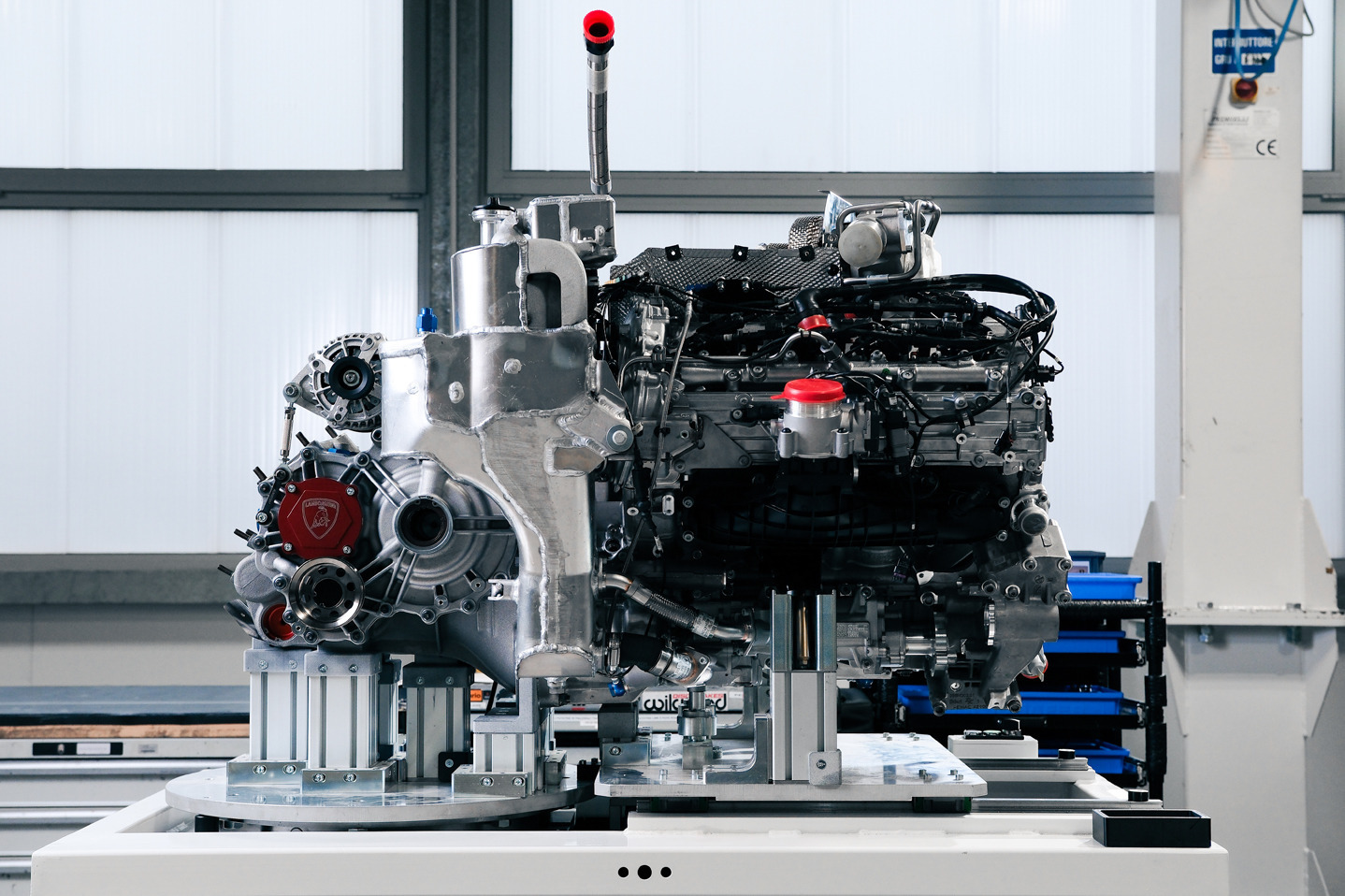
Photo by: Lamborghini
Motorsport first
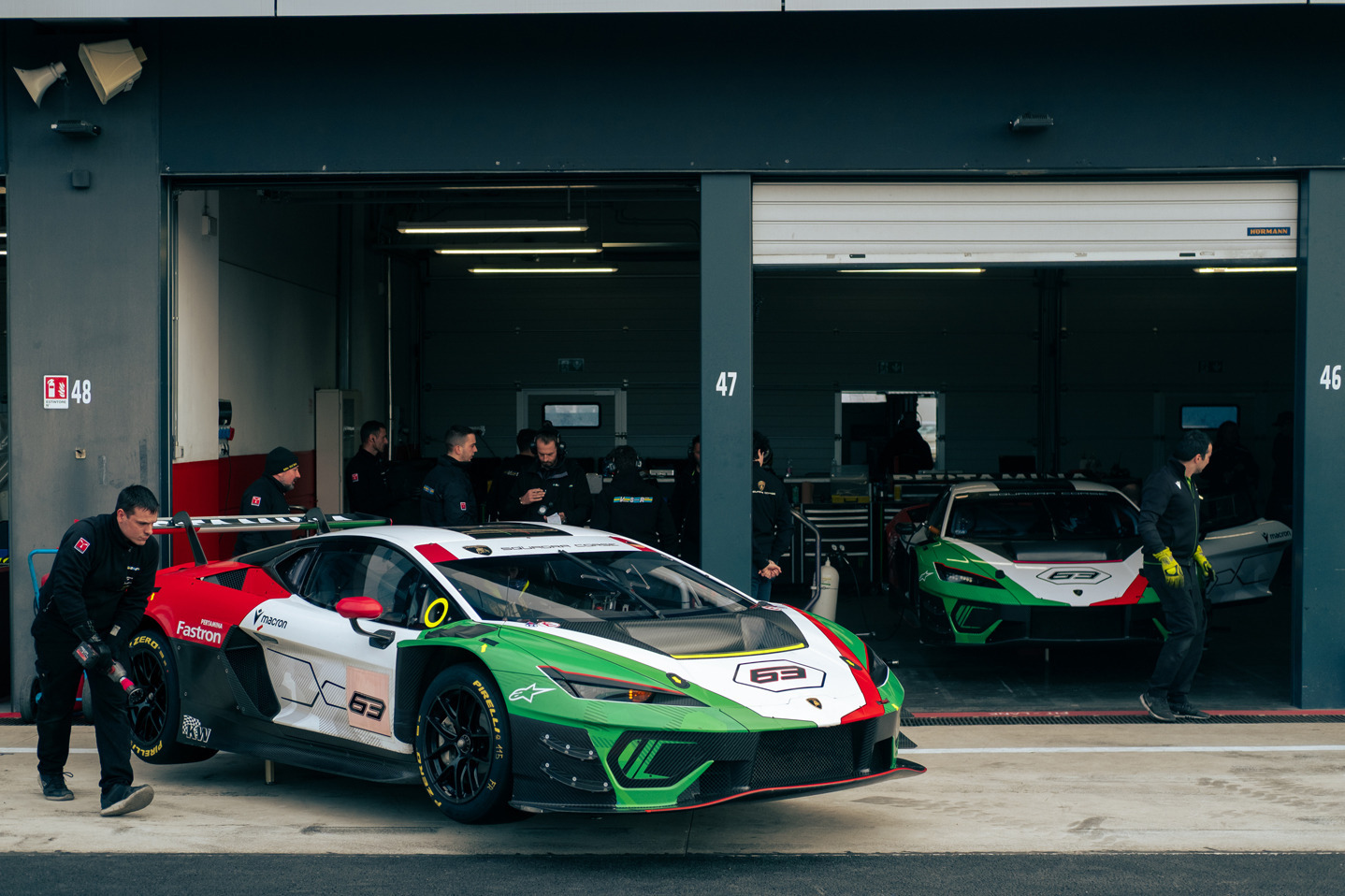
Developed in parallel with the road version, the Temerario GT3 features unique characteristics tailored specifically for racing, starting with the absence of the hybrid system used on the road car.
The same engineers responsible for the new four-litre twin-turbo V8 of the road-going Temerario were directly involved in developing the race engine, ensuring a faster development process and deeper technical understanding in both configurations.
“The idea was clear from the beginning: to have the possibility to develop a car designed from the outset for motorsport,” said project engineer Gianluca Silvestrini.
“Everything started with the chassis: it is an aluminium spaceframe that retains many elements from the production car, but in other aspects it has been completely redesigned. The front and rear sections, for example, were developed entirely from scratch to meet racing requirements.
“All the mounting points for the engine and gearbox have been reworked. We removed the elements required to support the electrical components used in the production car but not in the race car. Of course, the focus was on reducing weight and on another key factor we will mention several times: accessibility.
“During a race, especially in endurance events, it is essential to have very quick access to the car. For this reason, the various sections of the spaceframe are fully removable and can be replaced even during a race.
“Particular attention was also paid to development and calibration, especially in terms of drivability. To achieve this we worked extensively on engine delivery rather than outright power, since in many championships that is controlled independently by the Balance of Performance.”
Lamborghini Temerario GT3
Photo by: Lamborghini
Directly connected to the engine is a brand-new six-speed sequential gearbox with a transverse layout.
“This architecture was chosen mainly to reduce overhang mass and achieve excellent vehicle balance, while also meeting accessibility requirements and reducing the time required to work on such a critical component,” Silvestrini explained.
“Other key elements in developing this component were reliability — because endurance races place extreme stress on the gearbox due to vibrations — and precision, which directly translates into performance.”
As part of the new car’s development, its suspension design was also extensively revised.
“As we know, the suspension is the mechanical element that transmits the feeling of the road directly to the driver. The geometry has therefore been completely redesigned while maintaining the architecture of the Huracan, with the aim of increasing stability and predictability. This gives drivers greater confidence, which ultimately translates into performance on track.”
Development open to customer teams
Another key element in the development of the Temerario GT3 was Lamborghini Squadra Corse’s decision to involve its reference customer teams. After an initial phase handled directly by the manufacturer with factory drivers — primarily Marco Mapelli and Andrea Caldarelli — teams were able to take part in the testing and set-up work.
This approach significantly shortened the time required to transfer data and operational knowledge from the manufacturer to the teams that will run the car on track. Among them in 2026 will be Pfaff Motorsports — which will debut the car at Sebring — as well as Rutronik Racing, Grasser Racing Team and VSR.
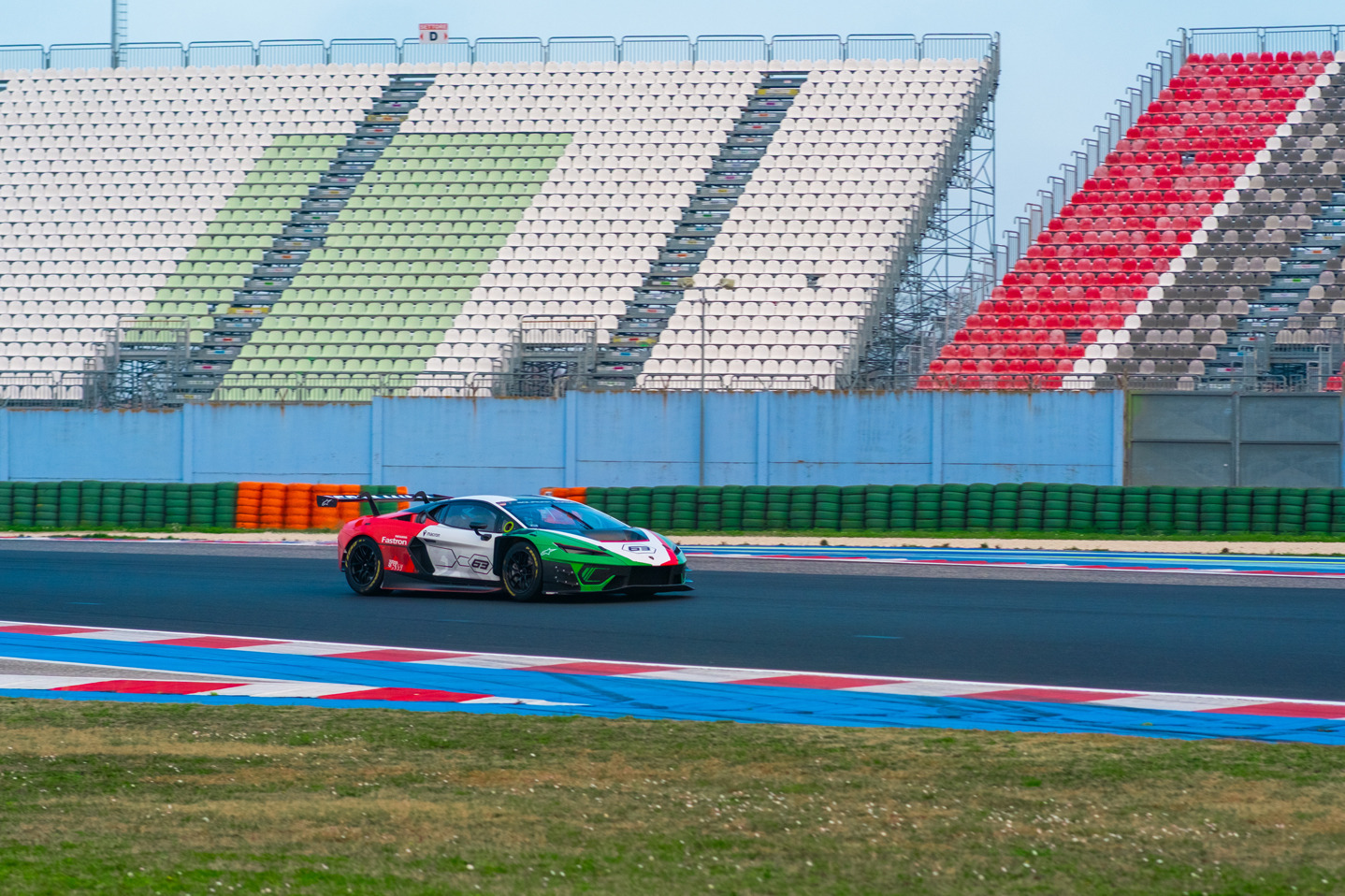
Strong foundations allowed the programme to complete more than 15,000 kilometres of testing across various circuits without major reliability issues, strengthening confidence ahead of the debut.
“With the Huracan we built experience and technical confidence. Especially with the EVO and EVO2 versions, the car became increasingly independent and aligned with Lamborghini’s philosophy. That project gave us very solid foundations and when that happens you feel it immediately,” said Mapelli.
“The Temerario GT3 is derived from the road-going Temerario, whose development I was also involved in. Both projects essentially started from a blank sheet, managed directly by Lamborghini and the Squadra Corse team. Obviously the GT3 is related to the road version but without the hybrid component due to the regulations.
“We began testing in June 2025, just before the summer. The car immediately proved solid, particularly in terms of the power unit. Reliability allowed us to complete a lot of kilometres in a short time. It has been the strongest point of the Temerario GT3 since the first test.
“Of course you need to get to know the car, but it responds very clearly to set-up changes. That’s a big advantage because it allows you to understand it progressively as you develop it.
“The objective was clear: to make it easier to drive, shifting and widening the operating window. After 10 years of Huracan development we had increasingly focused on pure performance, sometimes at the expense of drivability. With the Temerario the goal is to recover that balance while maintaining competitiveness.”
Lamborghini Temerario GT3
Photo by: Lamborghini
Comparing the Temerario with Lamborghini’s previous GT3 contender, Mapelli added: “The Huracan was extremely competitive, but it wasn’t always easy to drive at the limit. With the Temerario we worked to make the car more accessible, especially for gentleman drivers, while still maintaining top-level performance. The new twin-turbo V8 delivers significant torque and very interesting characteristics, even though we will have to say goodbye to the extraordinary sound of the naturally aspirated V10.
“Together with the teams we work on developing all the systems, because every championship has its own regulations and specific features — such as pit stops, pit lane starts, restarts or particular rules — where the car and its systems need to be adjusted for each series.
“This is certainly the most important phase of fine-tuning, where you can really make the difference. Having the opportunity to do this together with the teams competing in the championships allows us to broaden the shared experience even further and consequently increase the effectiveness of the changes that are introduced.”
We want your opinion!
What would you like to see on Motorsport.com?
Take our 5 minute survey.
– The Motorsport.com Team


