

rewrite this content and keep HTML tags
Since joining Scuderia Ferrari in 2023, Deputy Team Principal Jérôme D’Ambrosio has gradually assumed a more prominent role within the team, gaining significant attention after stepping in to oversee team operations in place of Team Principal Frédéric Vasseur during the 2025 Austrian Grand Prix weekend—a race weekend during which Charles Leclerc secured a well‑deserved return to the podium. The following weekend at the iconic Silverstone Circuit in the United Kingdom marked another turning point for Jerome D’Ambrosio. There, the former Belgian racing driver granted an interview to a carefully selected group of motorsport journalists, discussing multiple pressing topics related to the Italian outfit. He placed a particular emphasis on answering one key question that has circulated throughout the paddock: precisely how much influence do Formula 1 drivers have on the technical development of both the current SF‑25 race car and the eagerly anticipated 2026 challenger, which will be constructed under a radically new set of technical regulations.
Jerome D’Ambrosio made it clear that the newly introduced floor design and a series of smaller aerodynamic updates brought to the SF‑25 since the Austrian Grand Prix have provided exactly the performance gains that the Ferrari engineers and technicians had predicted. According to his account, these carefully engineered upgrades achieved what the Maranello team had hoped for: a measurable increase in aerodynamic downforce and a noticeable improvement in lap times. He emphasized that contemporary performance validation tools enable the team to rapidly assess the impact of upgrades. By the Friday morning practice sessions in Austria, the telemetry data had already confirmed the effectiveness of the package, making further on-track evaluation unnecessary before race time.
The Ferrari Deputy Team Principal elaborated candidly on the multi-stage validation process that Ferrari employs when engineering new components. This meticulous procedure begins with advanced Computational Fluid Dynamics, progresses through rigorous correlation in the wind tunnel, and culminates in live-track testing. The final step—real-world correlation—validated the wind tunnel results on the racetrack, which in turn reinforced the engineering department’s confidence in releasing the upgrade package for competitive use.
When discussion turned to the role that driver preferences play in the car’s development trajectory, Jerome D’Ambrosio acknowledged that tailoring the car to match individual driving styles is an important consideration. However, he emphasized that all development begins with establishing an optimized foundation—both mechanically and aerodynamically. The Belgian noted that Charles Leclerc had recently adapted his setup toward a more oversteering configuration, which had yielded strong performance across multiple races—though it struggled in wet conditions at the Silverstone circuit last weekend. Similarly, seven-time Formula 1 world champion Lewis Hamilton has also begun trialling comparable setups. Jerome D’Ambrosio explained that modern Formula 1 technical regulations inherently produce cars that feel twitchy and unsettled through corner entry. The Ferrari Deputy Team Principal added that drivers must learn to manage this phenomenon regardless of their individual preferences, emphasizing that it represents a universal challenge faced by the entire grid.
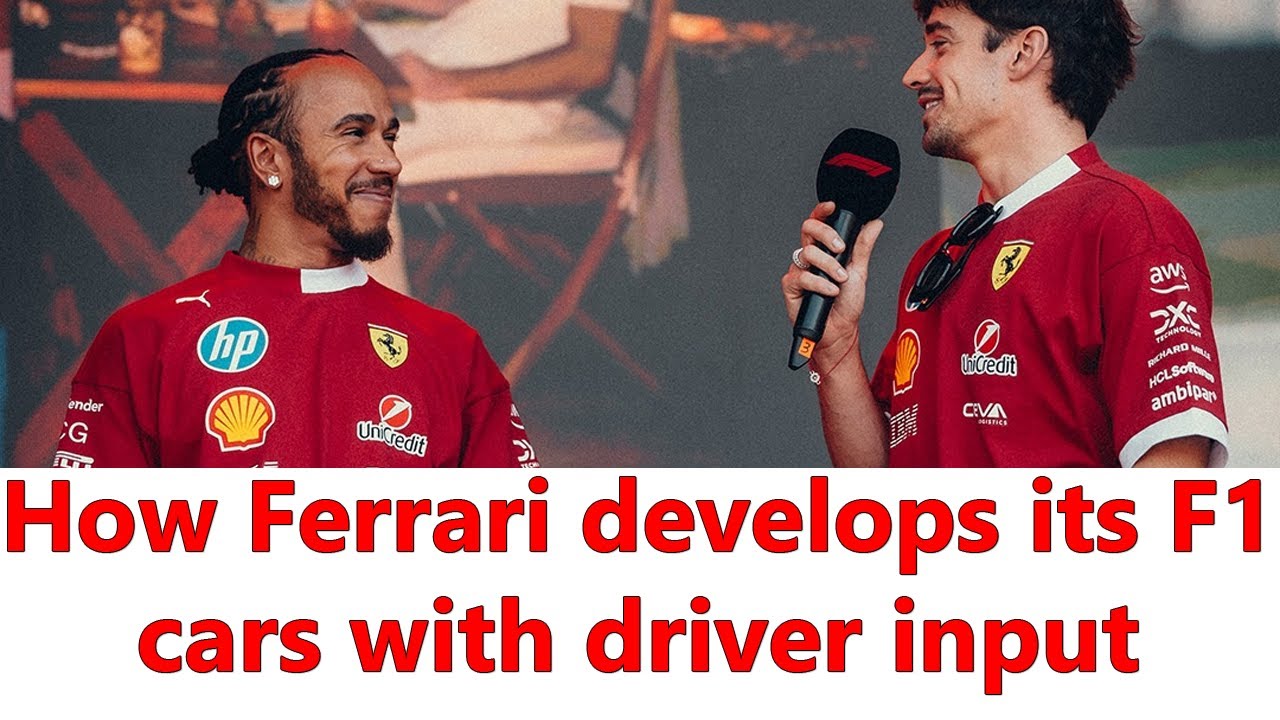
Jerome D’Ambrosio firmly dismissed any suggestion that Ferrari’s two star drivers were pulling development in fundamentally different directions. He confirmed that both Charles Leclerc and Lewis Hamilton frequently express remarkably similar technical requirements during structured debrief meetings held at Ferrari’s technical centre in Maranello. The engineering team, he explained, first prioritizes the car’s raw performance, which means lap time, aerodynamic efficiency, mechanical grip—and then makes refined adjustments in order to accommodate each driver’s comfort and style. In Jerome D’Ambrosio’s view, this dual‑phase process ensures that the car is fast in universally measurable terms, while also providing sufficient flexibility so that each driver can extract maximum performance in their preferred manner.
He further detailed how this development approach unfolds. The first phase establishes a baseline setup, determined entirely by objective performance criteria. Once that baseline is achieved, the second phase incorporates nuanced refinements based on driver feedback, such as brake bias adjustments, differential mapping, or specific aerodynamic tweaks. Concerning the imminent debut of Ferrari’s new rear suspension system, Jerome D’Ambrosio explained that while the underpinning motive remains performance improvement—specifically enhanced balance and tyre life—it will also provide more predictable handling characteristics, aiding both Charles Leclerc and Lewis Hamilton.
Looking ahead to the 2026 Formula 1 car, which will be designed under an entirely new technical framework, Jerome D’Ambrosio emphasized the strong collaborative relationship between drivers and the design team led by Technical Director Loïc Serra. He referenced Lewis Hamilton’s previous comments about his desire to help shape Ferrari’s 2026 project, leveraging his previous working relationship with Loic Serra at Mercedes. However, the Belgian former racing driver and motorsport executive took care to clarify that while driver input is welcomed and valued, the heart of the development program remains rooted in empirical performance targets and engineering judgment.
The Ferrari Deputy Team Principal highlighted that the development process is defined by objective performance metrics, such as maximising aerodynamic efficiency, mechanical grip, and lap-time potential, rather than being driven by individual driver preferences. While acknowledging the longstanding relationship between Loïc Serra and Lewis Hamilton, he stressed that Serra also maintains a close and trust-based professional rapport with Charles Leclerc, ensuring balanced consideration of both drivers’ feedback.
As part of Ferrari’s structured process, Jerome D’Ambrosio revealed that twice annually, the Maranello team convenes comprehensive workshops involving both Charles Leclerc and Lewis Hamilton. These sessions provide a forum for in‑depth discussion of their respective insights and ensure that the development roadmap aligns closely with driver expectations and performance goals. The overriding aim, he stated, is not to design a car solely around one driver, but rather to integrate universal performance parameters with driver-specific preferences.
In closing, Jerome D’Ambrosio emphasized that Ferrari’s current development strategy places maximum emphasis on refining the engineering process, as improvements on circuit performance and championship competitiveness are simply the measurable outcomes of a robust, well-structured workflow.
The process of Formula 1 car development is inherently iterative and relies on continuous collaboration between drivers, engineers, aerodynamicists, and simulation teams. Even the most seemingly minor component changes can influence the overall behavior of the car, and fine-tuning performance requires alignment across every department. As highlighted in Ferrari’s approach, the challenge lies not only in producing peak aerodynamic performance but in doing so in a way that integrates seamlessly with the specific requirements of the race team and the feedback gathered from drivers under live track conditions.
This is why modern Formula 1 development is as much about understanding human input as it is about refining computational models. Drivers remain central to this loop—not just as competitors, but as the ultimate sensors of the car. Their feedback, while subjective, is invaluable in validating wind tunnel data, simulator runs, and CFD projections. As teams like Scuderia Ferrari navigate the demands of this current regulatory era and look ahead to 2026, balancing driver comfort with performance remains an essential part of the equation.
Although engineers and technical staff prioritize raw numbers and simulation accuracy, finding a harmony between data-driven development and driver adaptability ensures the car performs consistently across diverse circuits and weather conditions. This becomes even more critical when managing two top-tier drivers like Charles Leclerc and Lewis Hamilton—each with immense experience and distinct driving styles.
Ferrari’s current strategy appears to prioritize a stable development platform that allows for adaptability on a per-driver basis. Rather than building a car solely around one individual, the focus remains on establishing a performance ceiling that both drivers can reach, regardless of personal preference. This philosophy not only reflects a team-first mentality but also reinforces the idea that sustained success in Formula 1 stems from consistency, clarity of direction, and trust in the internal process.
Ultimately, the real measure of any technical evolution will come from what is delivered on track. As the championship progresses and teams begin preparing for the next major regulation shift, the lessons learned today will carry forward, shaping tomorrow’s success.
— see video above —
And you? What do you think about how Ferrari’s driver feedback from Charles Leclerc and Lewis Hamilton shapes their 2026 F1 car? Let us know with a comment at the end of the article or on our social media channels: Facebook Group / Facebook Page / Instagram / X (former Twitter)
Jul 13, 2025
Let other Scuderia Fans know about us


