

[ad_1]
rewrite this content and keep HTML tags
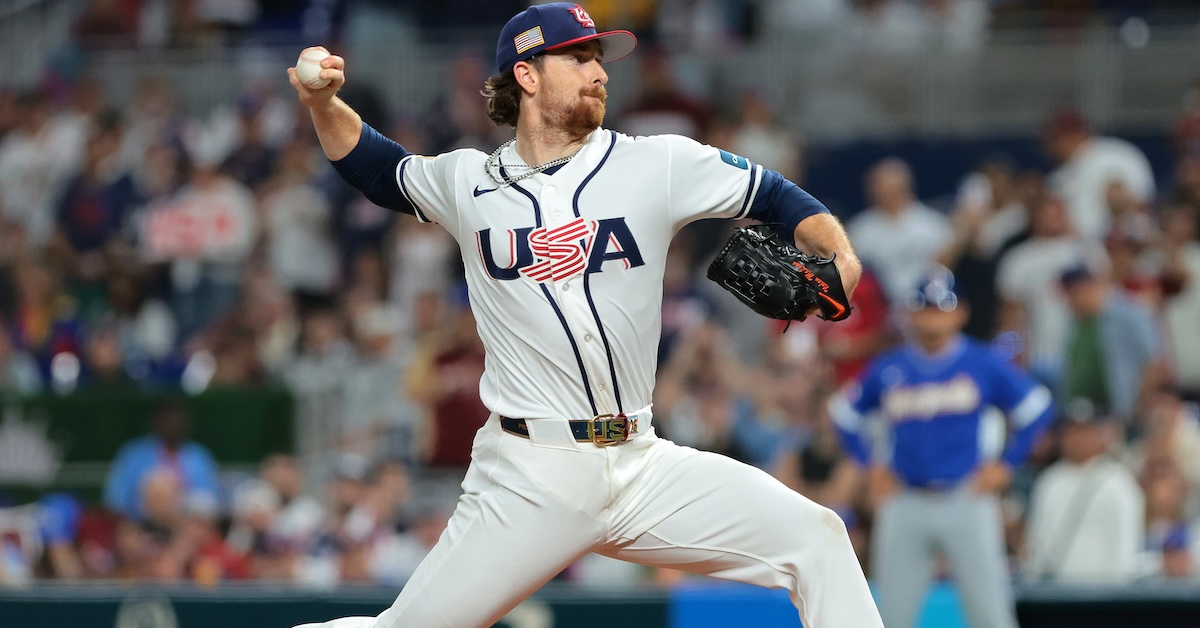
During the championship game of the World Baseball Classic, a Nolan McLean sweeper made me jump off of my couch. It wasn’t even a strike; it just moved so much from such an innocuous starting point that I reacted instinctively. I clearly wasn’t alone; Davy Andrews wrote about how nasty McLean’s pitches look last week. “Dang,” I thought to myself after I’d calmed down. “It’s too bad someone hasn’t gotten PitchingBot to take a look at that one.”
Then I thought about that slightly longer and chuckled. That someone is me. PitchingBot lives in the cloud, but I have a duplicate copy isolated in a sandbox on my computer. MLB records Statcast data for WBC games. I have a machine that ingests Statcast data and turns it into pitch modeling grades. This wasn’t rocket science (give or take how you feel about the machine learning algorithms powering the model) – I took the data, fed it into the machine, and tinkered with the exact settings until I got model grades to come out.
The tournament features a wide variety of skill levels, from Paul Skenes down to semipros and high schoolers. Setting the population average equal to the average quality of WBC pitching would mean that the grades aren’t comparable to the ones we’re all used to looking at. Thus, I ran the PitchingBot model for every pitch in the WBC, but instead of using the WBC average to mean a 50 grade, I used the 2025 MLB average. That means the model is calibrated to how you’d expect the pitches thrown in the WBC to perform against average major league opposition.
I had to make one other methodological decision, which I’ll cover briefly in this paragraph before getting to the results. For pitch-level grades, I adjusted by count in keeping with the methodology developed for the PitchingBot Visualizer. I did so because count affects stuff grades in particular, and thus those work best with large samples to normalize the count distribution by player. In a two-week tournament, that’s not going to happen. I chose to normalize by count for pitch-level grades, but to report overall grades using the exact PitchingBot methodology with no modifications.
As it turns out, that McLean sweeper was no fluke. Here are the best stuff grades among pitchers who threw 50 or more pitches in the WBC:
Top PitchingBot Stuff Grades, WBC
That’s right, on a staff with Paul Skenes, Tarik Skubal, and Logan Webb, McLean had the best stuff. He had the best stuff by a lot, and the best stuff of any starter in the tournament. I broke it out by individual pitches to get a sense for what drove his grade. The answer? Everything:
You Aren’t a FanGraphs Member
It looks like you aren’t yet a FanGraphs Member (or aren’t logged in). We aren’t mad, just disappointed.
We get it. You want to read this article. But before we let you get back to it, we’d like to point out a few of the good reasons why you should become a Member.
1. Ad Free viewing! We won’t bug you with this ad, or any other.
2. Unlimited articles! Non-Members only get to read 10 free articles a month. Members never get cut off.
3. Dark mode and Classic mode!
4. Custom player page dashboards! Choose the player cards you want, in the order you want them.
5. One-click data exports! Export our projections and leaderboards for your personal projects.
6. Remove the photos on the home page! (Honestly, this doesn’t sound so great to us, but some people wanted it, and we like to give our Members what they want.)
7. Even more Steamer projections! We have handedness, percentile, and context neutral projections available for Members only.
8. Get FanGraphs Walk-Off, a customized year end review! Find out exactly how you used FanGraphs this year, and how that compares to other Members. Don’t be a victim of FOMO.
9. A weekly mailbag column, exclusively for Members.
10. Help support FanGraphs and our entire staff! Our Members provide us with critical resources to improve the site and deliver new features!
We hope you’ll consider a Membership today, for yourself or as a gift! And we realize this has been an awfully long sales pitch, so we’ve also removed all the other ads in this article. We didn’t want to overdo it.
Nolan McLean’s Individual WBC Pitch Grades
Pitch
Pitches
Stuff
Command
Overall
Slider
40
63
56
59
Sinker
24
79
62
63
Four-Seam
22
68
70
69
Curveball
22
68
10
25
Changeup
6
59
58
61
Cutter
4
59
53
52
That’s a lot of gaudy stuff grades. The secondaries mostly matched his already-excellent 2025 numbers, but both fastballs graded out better in the WBC than they did last year. That’s partially a matter of throwing them harder – he was up by about two ticks in his two short-stint starts. It’s also partially a matter of them moving more. His sinker added two inches of arm-side fade even as he threw it harder. The WBC edition of his four-seamer had more induced vertical break despite the faster speed. Throwing harder and yet getting more movement anyway? That definitely explains the improvement.
That curveball command blemish? It’s real. McLean had trouble commanding the curve last year, as you can see from pitch model grades and also the fact that he landed it for a strike only a quarter of the time (league average is 43%). In fact, his poor curveball command is a great segue for a tourney-wide observation. The pitchers in the WBC had no command. Take a look at those top 10 pitchers by stuff grade, but this time with a few more statistics included:
PitchingBot Grades, Best-Stuff Pitchers of the WBC
Pitcher
Position
Team
Stuff
Command
Overall
Mason Miller
RP
USA
82
43
50
Edwin Díaz
RP
Puerto Rico
74
18
24
Eduardo Rivera
RP
Puerto Rico
73
28
36
Daniel Palencia
RP
Venezuela
72
35
40
Nolan McLean
SP
USA
71
52
56
Joseph Contreras
RP
Brazil
67
14
15
Luinder Avila
RP
Venezuela
63
50
50
Ben Simon
SP/RP
Israel
62
22
27
Keider Montero
SP/RP
Venezuela
61
34
35
Yoshinobu Yamamoto
SP
Japan
61
50
48
No one had a clue where the ball was going. I think that’s reasonable, in retrospect. It’s still spring training. It takes a while to get into regular-season form, and the WBC is also a disruption to routine. Instead of a normal low-pressure environment suitable for slowly rounding into form, you’ve got fans with cowbells, amped dugouts, and must-win situations. It’s a recipe for worse command, basically. It’s not just this list; if you take every pitch of the WBC in aggregate, the model spits out a result of 51 stuff, 42 command, and 40 overall.
Díaz, who had the worst command grade among major leaguers to appear in the tournament, was clearly working through some rust. He located around 30% of his sliders in the shadow zone — the edges of the strike zone and the area just outside of that — and missed way outside with many others. He’s closer to a 40% shadow zone rate in major league data. His fastball was even worse; he threw 28 of them, and only hit the strike zone 10 times. Even great pitchers aren’t always in peak form early in the year.
I want to give a particular nod to Joseph Contreras, son of Jose Contreras. He’s a Georgia high schooler and Vanderbilt commit eligible for the 2026 draft. He played for Team Brazil and dialed up some of the highest-octane stuff in the entire tournament. Just one problem: He couldn’t get anywhere near the strike zone. Here’s a shocking graph of his four-seamer locations:
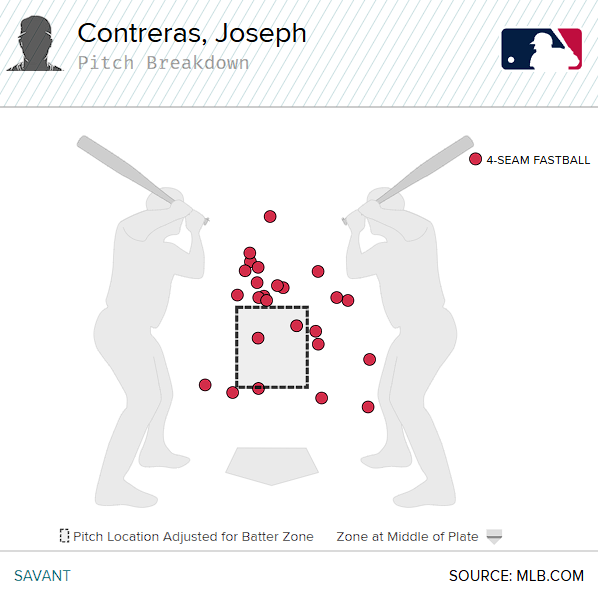
If those pitches were well-located, they’d play in the big leagues today. He sits 95-96 with excellent movement. It’s a good reminder that pitching is about more than just stuff; in fact, if you can’t get the ball in the strike zone, your stuff almost doesn’t matter. That’s why the model gave Contreras an overall grade that almost perfectly mirrored his command. Pitches like his – nasty, but nowhere near the zone – just don’t induce swings, no matter how good their shapes.
The best-graded players overall were the ones who displayed acceptable command:
Top PitchingBot Overall Grades, WBC
That’s a window into the limits of small-sample data. If you ask the pitching models who the best pitchers at the WBC were, they’ll give you a list of guys who kept the ball around the strike zone. If you ask them who had the nastiest stuff, they’ll give you a list of guys who hurled explosive fastballs and sliders right into the dirt.
If there’s one takeaway I had from hooking up PitchingBot to WBC data, it’s that McLean’s stuff is as good as it looked to me on TV. But if there are two takeaways, it’s that international tournaments like this are incredible. Here, take a look at what PitchingBot thinks of the 10 guys who threw the most pitches in this year’s tournament:
Selected PitchingBot Grades, WBC
Pitcher
Team
Pitches
Stuff
Command
Overall
Paul Skenes
USA
131
56
48
42
Aaron Nola
Italy
128
55
58
54
Luis Severino
DR
128
55
52
53
Dylan DeLucia
Italy
127
50
47
41
Logan Webb
USA
123
46
52
48
Yoshinobu Yamamoto
Japan
122
61
50
48
Livan Moinelo
Cuba
122
49
41
45
Nolan McLean
USA
118
71
52
56
Ondrej Satoria
Czechia
115
34
49
42
Michael Soroka
Canada
112
59
44
46
Name me a funnier grouping of three pitchers with nearly identical grades than Cy Young winner Paul Skenes, Guardians 40th-ranked prospect Dylan DeLucia, and full-time electrical engineer Ondrej Satoria. There’s a reason that stuff stabilizes more quickly than command. Skenes just wasn’t clicking on all cylinders in this tournament, which can happen to anyone. You know the old trope about a pitcher making one mistake and a hitter pummeling it? Try to figure out which of the five hanging sweepers thrown to righty Dominican batters (circled in red) got hit for a home run:
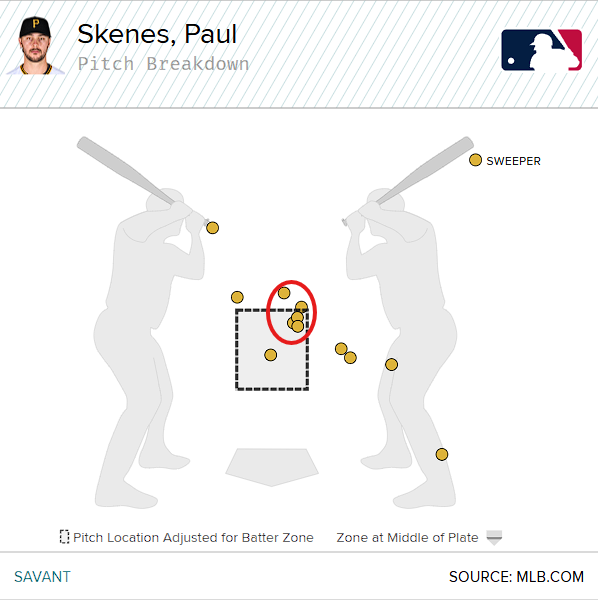
Don’t bother looking for which sweepers the opposition swung and missed at; Skenes didn’t miss a single bat with a breaking ball in the entire tournament. There’s just not a lot of predictive power to be found in 130 pitches, even if they’re thrown in an important competition.
Was it worth producing pitch modeling grades for the WBC? I think the answer is a clear yes, even if the results don’t revolutionize my understanding of the game. I love gawking at great pitches, and it’s even more fun when I have the numbers to back up how I feel. I love weird results; it’s delightful that Satoria and Skenes are equal here, and it’s delightful that a 17-year-old high schooler appears near the top of the stuff leaderboard. And if you’re looking for those leaderboards, you’re in luck. Here is a list of pitchers and stuff, command, and overall grades. Here is a list broken down by individual pitch types and adjusted for count. Happy perusing.
[ad_2]
Source link


