

[ad_1]
rewrite this content and keep HTML tags
Golota gets eleven stitches, his head smashed open with a two-way radio. His trainer, 74-year-old Lou Duva, leaves the ring on a stretcher and is taken to hospital. More than twenty others injured, fourteen arrested. Mayor Rudy Giuliani sequestered for his own safety in Golota’s dressing room. Riddick Bowe with an icepack between his legs. A riot in the Garden, and it’s ugly all around.
Six years earlier, Andrew Golota comes to the United States from Poland, fleeing prosecution for charges stemming from a bar brawl. Though he’s racked-up over a hundred wins as an amateur and won the bronze medal in the 1988 Seoul Olympics, Golota has no intention of becoming a professional boxer. He gets married, moves to Chicago, plans to work as a truck-driver.
Raised in the Warsaw ghetto, Golota grew up hard, tough, a street fighter. This is what he knows, and it calls to him. Eventually he’s drawn back into the ring and turns pro in 1992. He wins all eight of his fights that year, seven by knockout.
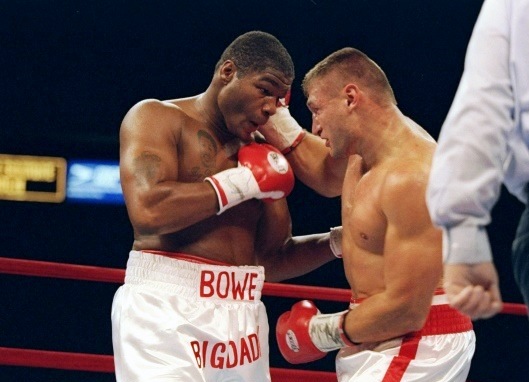
He continues on like this, mowing down opponents. A beast in the ring, great jab, brutal power. Despite his unbeaten record, he doesn’t gain significant attention until his match with Samson Po’uha in 1995. He wins the fight by TKO in the fifth round after knocking his opponent down five times, but the bout also shows Golota’s reckless nature: after taking a series of hard shots, in desperation he resorts to biting Po’uha on the neck. He’s later heard saying to his trainer between rounds, “I had to bite the motherfucker.”
A year later, against Danell Nicholson, a frustrated Golota delivers one of the nastiest intentional headbutts in the history of the sport. He goes on to win despite the blatant foul, stopping Nicholson in the eighth. With a 28-0 record that includes twenty-four knockouts, Golota is becoming recognized, but perhaps as much for his viciousness as his boxing skill.
Meanwhile, Riddick Bowe has just won a rubber match against Evander Holyfield by eighth round knockout. Bowe is the top heavyweight in the world, loving the lifestyle, the fame and all that comes with it. He is a powerful fighter, huge, strong, talented, but he lacks dedication. His weight fluctuates, something he has struggled with for years. He prefers traveling the country in his promotional “Bowe Bus” to working out, hitting barbecue joints rather than the gym.
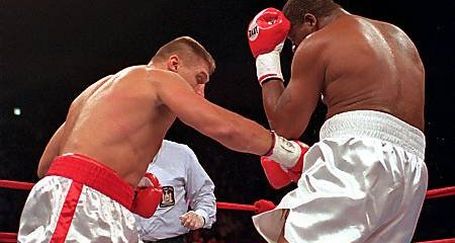
When the match against Golota is proposed, Bowe snaps it up, viewing the big Pole as an easy payday, a “bum” he doesn’t need to train for. Golota himself is hungry, pegged as a 12-to-1 underdog, determined to show Riddick Bowe and the rest of the boxing world that he is not to be taken lightly.
There is a charged atmosphere in Madison Square Garden the night of Bowe vs Golota, the former champion’s home town supporters out in big numbers. Meanwhile, Golota, the first Polish boxer to reach this level in the heavyweight division, also draws many fans. There is tension in the crowd even before the first bell, lines drawn, both racial and nationalist.
Wanting to keep things civil, and aware of Golota’s penchant for dirty fighting, referee Wayne Kelly speaks to the underdog in his dressing room before the fight. Golota tells him, “I do what I have to do to win.”
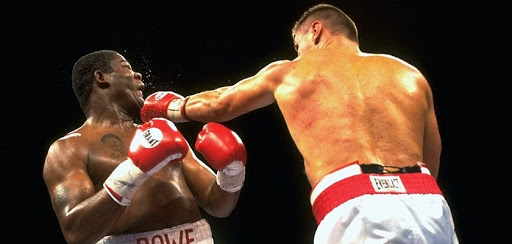
Riddick Bowe enters the ring at a career-high 252 pounds, and he looks slow, his defense terrible. From the outset Golota is attacking, getting off first, scoring with the jab and outworking “Big Daddy.” Bowe steadily slips behind on the cards; it’s Golota’s fight all the way. He looks comfortable, belongs there. Which is what makes his self-destruction so frustrating to watch.
Golota is winning the fight, controlling Bowe, and yet he chooses to slam shots below the belt, repeatedly. He’s warned by the referee three times for low blows before being docked his first point. Is it that street mentality, that do-what-you-got-to-do mindset that makes him want to foul Bowe? Or is it a desire to hurt his cocky opponent, to punish him, to teach him a lesson? Either way, Golota ends up being docked another two points for low blows before referee Wayne Kelley tells him that if he hits Bowe with one more shot south of the border, he’ll be hitting the showers.
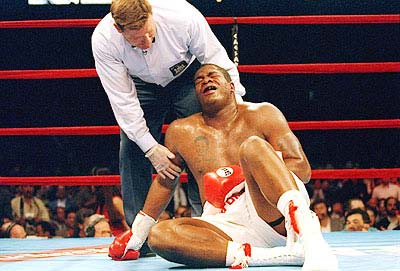
Inexplicably, in the seventh round, while ahead handily on the scorecards and almost assured the victory, Golota delivers yet another shot to Bowe’s testicles, a hard left uppercut. Riddick falls to the canvas in sections, grimacing, his gloves between his legs. Golota is disqualified.
The Garden erupts as Bowe’s handlers charge across the ring. A member of his security staff, Jason Harris, breaks a two-way radio over Golota’s head. Lou Duva grabs his chest and hits the mat, his heart giving out. The ring is stormed from all sides. The crowd, angered at the non-result of the fight, the empty payoff, start climbing over the ropes. The ones remaining in the stands direct their frustrations on each other. It’s madness in every direction.
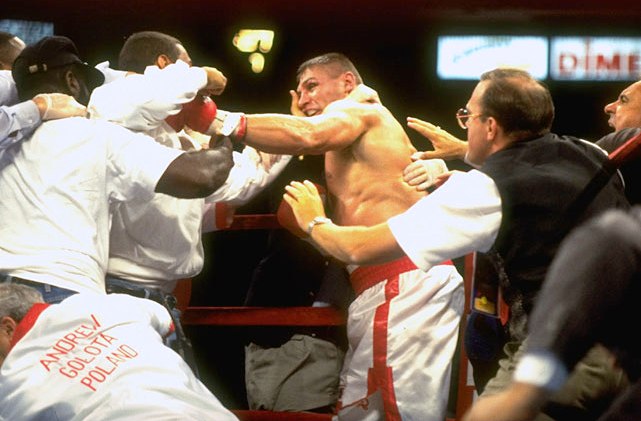
Viewers at home hear George Foreman, providing commentary for HBO, calmly reasoning with rioters: “Don’t do it, son … don’t do that … I know you want to, it’s going to be alright. It’s going to be alright.”
Things get way out, long gone, wild. Everyone’s throwing punches now, kicks too. It’s all emotion, the animal instinct that motivates the boxer but which is reined in by the rules of the sport, is now let loose through the stadium, wreaking havoc, possessing the crowd, waves of sick, brutal energy shooting off.
It takes police half an hour to get things under control. Some go to jail, some to the hospital. But there remains that feeling of unfinished business, of unfulfilled expectation. And so the rematch takes place on December 14 of the same year. And Golota is once again disqualified for low-blows. Madness.
Nothing good comes to either man after this. The two fights mark them, shake them up, and they never regain the momentum they had.
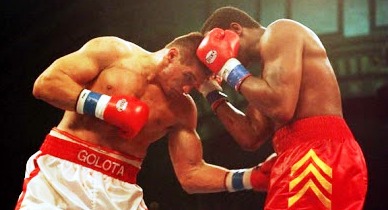
In his next match, Golota is knocked out in less than two minutes by Lennox Lewis. Naturally, he isn’t offered any significant fights for a while and when he is, versus Michael Grant in 1999, he is stopped again. He later loses to Mike Tyson, John Ruiz and Lamon Brewster, and spirals downward to obscurity …
Bowe goes out in a somewhat more spectacular, and saddening, fashion. After the second fight with Golota, he quits the sport of boxing to join the Marine Corps, only to drop out after three days. Upon returning to civilian life he’s accused of beating his sister. He then kidnaps his wife and children at knifepoint and tries to take them to Maryland. He’s arrested again in 2001, domestic dispute with the wife again. It’s speculated that all these bizarre actions may be attributable to brain damage, resulting from the punishment he received in the ring. It’s all badness, darkness.
July 11, 1996. The night Bowe and Golota will always be remembered for, and the beginning of the end for both.
— David Como

[ad_2]
Source link


