
[ad_1]
rewrite this content and keep HTML tags (remove this from content : rewrite this content and keep HTML tags)
Celebrate the financial uprising of the WNBA, if you must. Yet just because the women finally were paid doesn’t mean the league suddenly surges between May 8 and mid-October. The trick is to avoid the snobby undermining of entire seasons, with women’s basketball already lagging behind the thunder of what’s happening in American sports.
When Opening Night arrives, competition includes the NBA playoffs, an MLB season, the NHL playoffs, the golf and tennis majors and the emergence of 47 World Cup nations to join Team USA. Then what? The NFL and college football never go away, followed by baseball’s postseason. Sure, it’s sweet justice that Caitlin Clark, A’ja Wilson and other stars will make $1.4 million this year with new super-max contracts.
That is far less than an NFL punter makes, or a baseball utilityman. Bronny James earns $1.955 million when he no longer is used by the Los Angeles Lakers. Please acknowledge where the WNBA stands right now — contrary to incessant ego-babble — after the approval of a collective bargaining agreement extending through 2032.
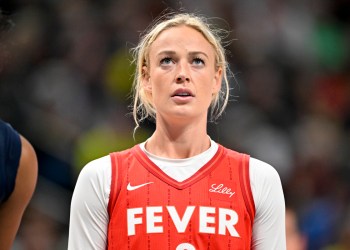
How does the commissioner, still Cathy Engelbert, band together with freshly committed owners and keep selling the sport to TV viewers and arena audiences? When the players receive 20 percent of gross revenue and benefit from a 364-percent increase in their salary cap, they’ll need to average more than 1.2 million viewers on broadcasts. Last year, Clark’s team in Indiana scheduled nine games in bigger-than-usual buildings.
This year, the number was reduced to four.
Desperation was the reason for last week’s handshake. I wasn’t kidding when I wrote Clark was better off starting her own league, knowing how prominent she is in March ads and how Nike is retailing her signature sneaker for $140. At least her salary will soar above the $78,066 she made last year. That said, paying her $1.4 million — and around $2.4 million in seven years — remains a mockery. She’s the one who lured 18.7 million viewers for her final game at Iowa, the one who dealt with sick foes beating her up during pro games.
But Engelbert said Clark should be on her “knees” for the media deals she formulated, according to Minnesota’s Napheesa Collier. The commissioner’s departure can’t happen soon enough, with my thought-out successor — Barack Obama — still in play if he prefers. “This Collective Bargaining Agreement represents a defining moment in the WNBA’s 30-year history,” Engelbert said. “Since its inception, the WNBA has been shaped by extraordinary athletes who believed in the league’s future. The agreement is a testament to that belief and to the tremendous progress we have achieved together.”
The Players Association is thrilled to cut a deal that preserves the players’ existential place. “This transformational CBA delivers consequential economic progress and expanded benefits that support players on and off the court,” the union said. “It builds a stronger foundation for today’s players, the next generation, and those who helped build the WNBA. It affirms the strength of our union and the power of our collective voice. Now, it is time to get back to the game and the fans we love, competing at the highest level, and showing exactly what this league can be.”
Said Nneka Ogwumike, Players Association president: “We came in understanding that engagement and participation were key. We were always true to our process, and we were going to end the process in the way we know our governance to work. With ratifying the vote, with getting voter turnout. I will say there were a lot of outside forces that were trying to, you know, crack our foundation. Didn’t work. We stood strong. And I feel like we can’t necessarily see them as roadblocks or obstacles, it just really bolstered and fortified exactly how union-strong we are. I mean, one thing about athletes is that we have stamina.
“We were going to make it to the end no matter what.”
I’ll watch Clark until she’s 90, as she tries to escape more injuries. But the country has had a taste of Wilson, Collier, Breanna Stewart and Paige Bueckers — will we want more, or assume the league is secondary? The sports dollar has too many options. It could be the WNBA has peaked.
So teams fly on charter flights. So life insurance increases to $700,000 a player. Mental health has been addressed. Training is on the plateau of other leagues. Beautiful, for all.
But I want to know if players who complained for months — years — will improve the splendor of performance. A $7 million salary cap, five times bigger than last year, means owners will spend to win. Do not forget the massive question about a 364-percent hike in salary cap.
Will Americans even care?
###
Jay Mariotti, called “without question the most impacting Chicago sportswriter of the past quarter-century,’’ writes general sports columns for Substack while appearing on some of the 1,678,498 podcasts and shows in production today. He is an accomplished columnist, TV panelist and talk/podcast host. Living in Los Angeles, he gravitated by osmosis to film projects.
[ad_2]
Source link